Before every class I ask the yogis in the room if they want to work on anything in particular. What I usually hear are a list of body parts. Low back, shoulders, neck, upper back, hips, hip flexors, and then less frequently, core, knees, feet, and wrists. Sometimes people request specific poses or techniques, like breathwork or forms of meditation. Occasionally someone will mention emotional issues like anxiety or grief.
Asking students if they have anything they’d like to work on can have many benefits. Most obviously, taking requests helps the teacher understand what poses, variations, and sequences should be used or avoided. It also helps the teacher know what to look for to help each student practice effectively and keep them safe.
Fielding requests can also help a teacher choose the best cues to use when describing the action of a pose or movement. If you have three or four students who have neck issues, for example, you might put more emphasis on describing the action of the shoulder blades and upper back in Warrior II than you would if you have a group with knee pain. If you have someone who is anxious, you can remind the group to lengthen their exhalations or cue them to feel the support provided by the ground beneath their feet.
Giving information that helps to offset undesirable patterns can also fuel a practitioner’s curiosity about the underlying mechanics of physical, emotional, and mental systems. Once a student feels how to engage the vastus medialis, for example, and sees how that relates to a reduction of knee pain, that student can then find ways to generate that engagement both throughout the rest of their practice and in other activities like walking or riding a bike.
Over time this can not only help students improve their ability to address issues in their bodies, breathing patterns, and the way they use their minds, but in the moment, it can help to turn attention back to the felt experience of the body, so that sensations continue to operate as objects of attention, which supports the meditative aspect of the practice.
And while all of these reasons feel like worthwhile reasons to take requests, perhaps the most important reason is that it gives the teacher an opportunity to connect with each student before class.
Making an honest fist of meeting students where they are at not only reminds me that I’m there primarily to help them if I can, it helps to create that cohesive feeling of satsang (a gathering of practitioners) which in the end, is the practice. Even if we think of our time on the mat as a way to relate to our own bodies and minds, it doesn’t take much reflection to see how this extends to our relationships with the people and world around us.
I wouldn’t argue that taking requests is something every teacher should to do. I’ve been to lots of great classes that feel exquisitely constructed with a kind of cohesive intention that might be difficult to create if the teacher is trying to fit in specific poses or practices requested by the students. Moreover, there are many ways to connect with students aside from taking requests.
But if you’re held back as I once was by a fear that you won’t be able to do the requests justice or that you might sound as if you’re arrogantly proclaiming your ability to heal through your yogic omnipotence (“You’re sad because your cat died? No worries. We’ll do headstand. Problem solved”), you might consider that, in my experience at least, students don’t tend to expect so much, and many of them just appreciate the consideration.
If you ever have any requests for class, feel free to reach out beforehand. The same goes for questions after class or any questions related to your practice, and if you’re looking for my class schedule, you can find it here.
If you want to get these blog posts by email, enter your address in the box below and click the blue button.
Processing…
Success! You're on the list.
Whoops! There was an error and we couldn't process your subscription. Please reload the page and try again.
We all know how it feels. You make what you thought was an innocent remark and suddenly you’re in a heated argument over politics. Or maybe you’re on your way to lunch when you realize that you’ve double booked yourself for the following afternoon, and it isn’t obvious how you’re going to get out of either commitment without paying a heavy cost. Or maybe you’ve just discovered that the presentation you thought was tomorrow, the one you haven’t prepared for, is actually today. In five freaking minutes.
Sometimes it’s even more elusive than that. A baseless fear or some old hurt gets dredged up by forces that are totally unobservable, yet still you find yourself in the grips, hijacked by your amygdala, cortisol and adrenaline flooding your body. Your pupils dilate, your breath becomes shallow, and your jaw sets. And while that quivering solar plexus and those shaking limbs might be useful if you had to fight off a bear or climb a tree to escape one, most of the time, this is the last thing you need.
Not only are these physical sensations unpleasant, when our bodies’ flight-or-fight responses get activated in this way, we lose the ability to think clearly, make complex decisions, and access multiple perspectives, which can cause us to get stuck in a rigid, defensive mindset. Our memories also become corrupted, which not only leads to more confusion, it can, in a conflict, cause us to forget that we ever liked the other person, even if it’s someone we love, making it more likely that we will do and say things we later regret.
Most people reading this will probably know first hand how a well-structured yoga class can help you downregulate your nervous system and that a regular yoga practice can lower your baseline away from these aggravated states, making you less likely to get triggered in the first place, but it will still probably happen from time to time, and unfortunately, it’s not always possible to bust out triangle pose whenever you get into an argument or start perseverating over some past offense or upcoming obstacle.
That’s why I thought I’d share these three techniques to help you quickly and efficiently calm your nervous system whenever you feel anxious, stressed, angry, or wired and it’s getting in your way.
1. The Physiological Sigh
The Physiological Sigh is an awesome technique that you can do just about anywhere. The technique is super simple. Take a quick, deep inhalation through the nose, then immediately suck in just a little more breath like you’re topping off your tank. Next, exhale completely and slowly through the mouth. Repeat for 2-3 rounds.
Here’s what it looks like (turn your volume on):
Here’s how it works:
When we’re stressed or anxious, our breathing speeds up and becomes shallow, which perpetuates the cycle of excitation. The two quick inhalations help to reset the pattern of breath, while the slow exhalation removes excess carbon dioxide from the body.
2. Extending the exhalations
Once we’ve been triggered and stress hormones have been released into our bodies, it takes fifteen or twenty minutes for them to clear out, and that assumes we don’t get locked into stress-inducing bodily patterns or patterns of thought that continue to release more stress hormones.
Not only is it a good thing to bear in mind that it will take a little time for you (or someone else) to calm down, it’s also helpful to have a technique that can be used to support that calming period and prevent you from unintentionally intensifying an excited state. One simple method that does both is the practice of extending your exhalations, and like the physiological sigh, this can be done almost anywhere.
How to do it:
Bring your attention to the breath moving in and out through your nose and count the length of your inhalations. Next, extend the length of your exhalation by a count of two. As an example, if your inhalation lasts for a count of 5, stretch your exhalation to last for a count of 7. By extending the exhalations in this way, you’ll inhibit the production of additional stress hormones and create what is known in yoga as a langhana effect.
Langhana, in this context, means to reduce or diminish back to its cause. According to Yogapedia, “In yoga asana practice, langhana postures are those that are more relaxing, slowing the heart rate, breathing and metabolism, relaxing the nervous system, and calming the mind.”
Again, this will take several minutes, so stay with it, returning to the breath count again and again each time your mind wanders. Focusing your attention on the count is important because it will help to prevent obsessive thinking or stress-inducing ruminations.
Please note that the exhalation doesn’t have to be extended exactly by two additional counts. You might prefer a rhythm with a slightly longer extension of the exhalation. Just make sure you don’t stretch the exhalation so far that it creates a strain.
3. The 61-Point Relaxation Technique
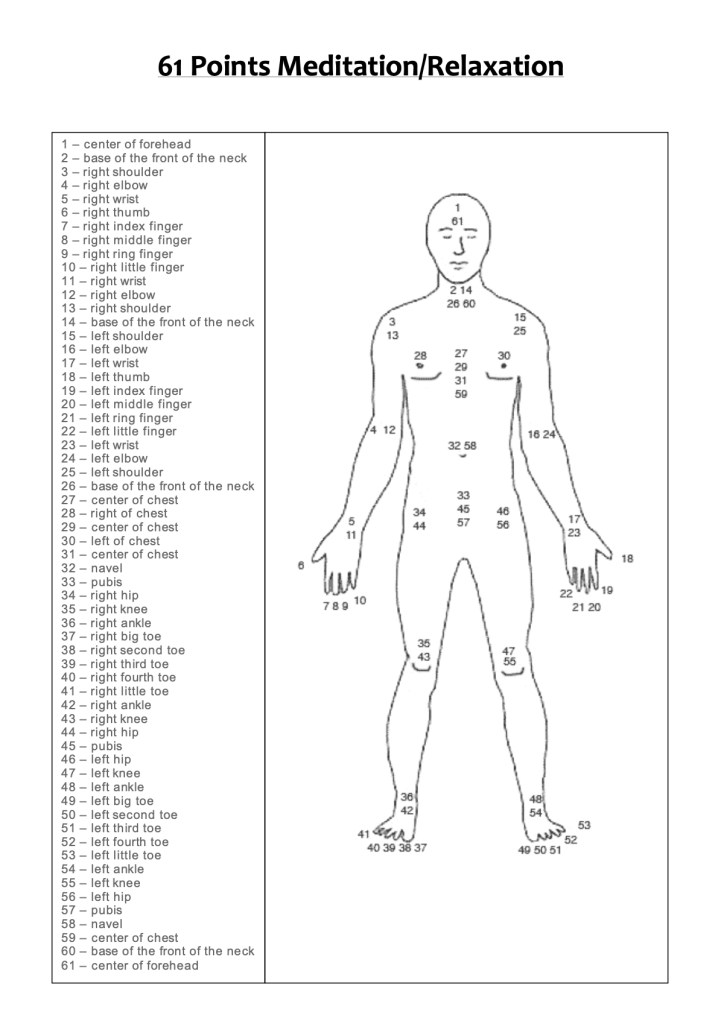
This is a technique I first encountered in a wonderful book called The Tibetan Yogas of Dream and Sleep, by Tenzin Wangyal Rinpoche. In it, the author introduces the 61 points as a method to induce lucid dreaming, but it can also be used as a stand-alone technique to calm the mind or as an entry point into yoga nidra, a state of non-sleep deep rest.
How to do it:
The practice is accomplished lying down and can take anywhere from a minute or so to upwards of ten. I’ve created a follow-along video below that you can try for yourself.
I frequently use this practice when I’m having trouble settling down at night or if I wake up and can’t fall back to sleep. I will also use it during the day when I’m feeling too keyed up and have a few minutes to lie down on the floor, couch, bed, or wherever, really.
Once you get accustomed to the practice, you can work with it on your own without the recording. Here’s a chart to help you learn the points in their sequence. You can download a printable pdf here.
It should be said that none of these techniques are guaranteed or even likely to work in the face of extreme states of agitation, but they can become useful tools to help you manage various levels of undesirable arousal. I think it’s best to play around with them to see what works in different contexts and how they can be adapted to suit your needs.
That’s it! Let me know in the comments if you find any of these techniques useful or have any of your own to share.
If you’re looking for my current class schedule of in-person and virtual yoga classes or a link to some of my follow-along classes on YouTube, you can find both here, and if you’d like to get the blog by email to stay updated on future offerings, you can add your address below 👇 and click the button.
Processing…
Success! You're on the list.
Whoops! There was an error and we couldn't process your subscription. Please reload the page and try again.
Hey everyone. Really liked this conversation with psychologist Rick Hanson.
I’ve read some of Rick’s books, including Buddha’s Brain and Neurodharma, and I always admire the way he supplies practices you can use to alter your neuroanatomy in order to create lasting positive changes.
In this conversation, there is a nice summation of his work to date and a survey of the scientific literature in the field. Dr. Hanson also does a deep dive on how savoring positive experiences in the moment can raise your happiness set point and increase your resilience.
Often times in yoga and Buddhism, there is a lot talk about seeing through illusion and letting go, but not as much on how to develop positive, pro-social traits that help us flourish in the world while still walking our spiritual path. Dr. Hanson, who is steeped in Buddhist practice, bridges this gap in a way that honors the tradition without diluting it.
This podcast is also available on your favorite podcatcher (if you want the audio only version), and Dr. Hanson has his own podcast as well (if you want to find more content from him at a zero dollar cost).
Thanks for your ongoing interest in the practice of yoga. The updated schedule of my classes is here.
Like many of you, I bought the six-year old in my life a giant Squishmallow plush toy last Christmas. It was the one thing she really wanted, and for weeks I was trying to find one that wasn’t hundreds of dollars. Why would anyone pay so much for these things, I wondered, and how do they make them feel so gross? In the end, I found a deal at Costco, and everyone was happy.
Yesterday our dog chewed it up.
I was sick, flat on my back, when it happened, and the kids were admirably playing by themselves while I slept, but that meant the puppy was unattended.
Was he mad that I’d thrown out the tattered remains of his dog bed earlier that day? He’d spotted me carrying it through the house. He was on the other side of the gate when I stuffed it in the bin.
My oldest daughter is convinced he was mad.
But why didn’t he destroy something of mine? I asked.
I was thinking the same thing, she said.
My nap ended abruptly when the Squishmallow’s owner came into the room, shouting and sobbing inconsolably. She had found her friend murdered and disemboweled on the floor of her room, murdered by another friend. I felt terrible for her and angry at the dog. I hauled him upstairs and put his face in it. I called him a bad dog, hoping that even if it was poor dog ownership, my daughter might feel my desire to stick up for her feelings.
Is there any chance the dog might somehow be able to link my displeasure with an act he’d committed in the distant past of five minutes ago? And that he might thereby be dissuaded from further destroying our shit? In truth, I wasn’t that angry in this instance, but sometimes I am. Angry at my lack of control. Puppies. Children. Myself.
How strange it is that we assume we can control our experience when we can’t even control our thoughts? Thoughts just arise, spontaneously, seemingly out of the ether, and if we can’t even control our own thoughts, which are precursors to our actions, how can we hope to control ourselves, let alone others? Throw in some additional randomness unrelated to the actions of sentient beings, like the car that won’t start or the roof leaking during a storm, and it’s pretty clear how much is out of our hands.
I’m not arguing that we should yield to chaos, but once we’ve embarked on a plan of action to improve an aspect of our lives or the world we live in, wouldn’t it be better if we could avoid feeding the self-referential thought loops about how we should have done this or that better or how we need to do those things better in the future?
Meditation can help with this, and not just in the way that learning to concentrate allows us to be selective about which thoughts we attend to, or even in the sense that we can learn to witness our thoughts with detachment so they feel less authoritative, but in the sense that it can help us recognize that we don’t exist in the way we tend to think we exist, that there is no self, no inner “me,” who needs to be promoted, berated, or defended.
After I put the dog outside, I got the shop vac from the garage and asked the girls if they wanted to help. It took only a moment for them to realize it would be kind of fun to play in the fluff.
After all, the Squishmallow wasn’t new anymore, and the puppy has destroyed so many of our things.
Besides, kids are good at letting things like this go. Better than us usually. They haven’t yet formed a rigid sense of themselves so there is nothing really for them to promote, berate, or defend.
In other words, there nothing for them to transcend, and in truth, there is nothing for us to transcend either because that inner me does not exist and has never existed, it just usually takes some looking for us to recognize it.
If you’re interested in learning how to look, you might want to check out Waking Up, the meditation app created by Sam Harris. In it you can find an ever-growing array of practices and information that can help with everything from learning to meditate to flourishing in daily life to dropping back into nondual realization (I should say here that I have no affiliation with Waking Up except as a subscriber).
And of course, I teach towards all of this in my yoga classes. You can find the in person and virtual schedules here.
Thanks for stopping by. If you want to get the posts by email, subscribe here. 👇
Processing…
Success! You're on the list.
Whoops! There was an error and we couldn't process your subscription. Please reload the page and try again.
May all sentient (and squishy) beings happy and free.
I’m bored. It’s not that I don’t have stuff to do. I do. Write this blog post for one. I could also clean the house, make dinner, start my taxes. 🤮
But I don’t want to do any of that.
I find myself thinking instead about eating a box of Girl Scout cookies, maybe watching some superheroes kickass. I haven’t seen Thor: Love and Thunder yet. Or I could go somewhere, do something, anything.
Boredom is a kind of pain. It’s not the same as a compound fracture of the tibia, or a sudden and unexpected death in the family, or any number of pain’s more exotic forms, but I can tell it’s pain because I feel the urge to escape it.
According to doctor Anna Lembke, the medical director of Stanford Addiction Medicine and author of Dopamine Nation: Finding Balance in the Age of Indulgence, I’m not alone.
“We’re all running from pain,” she writes. “Some of us take pills. Some of us couch surf while binge-watching Netflix. Some of us read romance novels. We’ll do almost anything to distract ourselves from ourselves.” (Lembke, Dopamine Nation, p. 44)
The thing is, we all know that pleasurable distractions often leave us feeling worse. One reason, according to Lembke, is that when we indulge in activities that cause a large release of the neuromodulator dopamine–a hormone that acts as a sort of in index of the addictive potential of an activity or substance–self-regulating mechanisms in our bodies tip the scale back towards pain to return us to homeostasis, or balance.
What’s more, if we chronically return to the activity or substance to find our escape, our baseline balance shifts away from pleasure towards pain. In Lembke’s words, “With prolonged and repeated exposure to pleasurable stimuli, our capacity to tolerate pain decreases, and our threshold for experiencing pleasure increases.” (Lembke, Dopamine Nation, p. 66)
If we do a quick catalogue of our many forms of pleasurable escapes, this can all start sound like a grim cycle (I know 😬), but fortunately for us, this process also seems to work in reverse, and it may be possible to leverage it to our benefit.
Lembke calls this “pressing on the side of pain.” She writes, “With intermittent exposure to pain, our natural hedonic set point gets weighted to the side of pleasure, such that we become less vulnerable to pain and more able to feel pleasure over time.” (Lembke, Dopamine Nation, p. 145)
I think most of us know what this feels like. For me, this is a fair description of what happens when I incorporate things like vigorous workouts and challenging projects (writing) into my day to day. These activities certainly generate some pain in the moment, but they often leave me feeling better, and when I’m consistent with them, my baseline experience shifts so it’s easier to appreciate simple pleasures throughout the other parts of my day, like playing with my dog or taking a walk with a friend.
“So wait a minute,” you may be thinking, “exactly how much pain are we supposed to seek out?” And to the yogis in the crowd, I see you waving your hands. Yes, yes, I know. Your yoga teacher told you to avoid pain.
Like your yoga teacher, I’m not advocating that you practice or live in such a way that you damage your body or mind. Indeed, the austerities performed by self-flagellating monks or hindu ascetics who hold an arm aloft until the appendage withers into an immobile stick are denounced in the yogic tradition.
“Some invent harsh penances,” Krishna tells Arjuna in the Bhagavad Gita. “Motivated by hypocrisy and egotism, they torture their innocent bodies and me who dwells within. Blinded by their strength and passion they act and think like demons.” (Easwaran transl., The Bhagavad Gita, 17:4-6)
In yoga, the objective is not to generate pain or mortify the flesh but to investigate our habit patterns and work skillfully with the pain that arises as a byproduct of the transformative action of the practice.
This process is called tapas, which is often translated as austerity or self discipline but literally means “heat.”
You may have discovered this heat when trying to hold plank pose even when your limbs are shaking and your mind is screaming at you to stop (for the love of God!), or perhaps you’ve experienced it while remaining still in meditation despite an overwhelming compulsion to get up and go do something else. Even off the mat, you’ve maybe felt this fire when you walk into a crowded room of strangers and manage to strike up a conversation even though you really want to go home and hide under the covers, or when your kids push boundaries and you withstand the urge to blow your top.
Along with cleanliness, contentment, self-study, and surrender to the higher self, tapas is one of the five observances, or niyamas, that form the second limb of the eight-limbed vehicle of yoga outlined by Patanjali in The Yoga Sutras, and it can be thought of as a metaphorical, purifying fire. Tapas burns away those habits of body and mind that form impediments to the full and clear expression of thought and action in our lives, and it usually involves some discomfort if not outright pain.
In The Practice of the Yoga Sutra, Pandit Rajmani Tigunait writes explicitly of the relationship between tapas and pain. “Tapas is withstanding the pain caused by the pressure of the senses and our self-imposed resistance to that pressure. Until we reach the highest, there is a constant tug-of-war between the good and the pleasant, between our discrimination and our desires, between the forces of surrender and the forces of attachment. Cultivating the capacity to withstand this pain and adhering to our resolution is tapas.” (Tigunait, The Practice of the Yoga Sutra, p. 172)
Taken out of context, this might sound a little like your high school weight-lifting coach hollering at you to push through it, but the idea isn’t to get adversarial with your pain or use brute force to overcome it, nor is the idea to dismiss pain as mere noise.
When pain arises on or off the mat, the skillful response usually includes paying attention. This is automatic when you, say, touch a hot stove, but at other times the pain might feel easier to dismiss, like when you are working with a yoga pose or when you’re feeling depressed. Sometimes the best path is to forge ahead and endure the pain, but oftentimes we need to back off, modify, ask for help from a teacher, friend, or doctor. Sometimes we need to skip it all together if we can. Paying attention moment by moment is probably one of the best ways to discriminate between those moments when we should consider withstanding the pain in order to “adhere to our resolution” and those moments when we should let that shit go.
Learning to discriminate between the useful forms of pain and the other is a fickle art, but paying attention to pain as it arises moment by moment can also have the benefit of helping us shift our relationship to it from one of of reactivity to one of skillful response and observation.
Richard Freeman describes this action beautifully and, in the process, captures a reciprocal relationship between pain and simple pleasure that resembles the one described by Anna Lembke.
When people first experience tapas, there is often a sense of discomfort, a desire to squirm away from the situation because it is so authentic; it is as if the border of life is being eaten away by fire. But if we stick with the observational practice, if we do not run away when we reach the juncture where tapas first arises, then we can gain an incredible insight into the fact that all things do change. Not only do we understand this conceptually, but we can experience the impression of this principle of transformation within the body; we feel through our deepest physical sensations, right into the core of the body. When we perceive change in this way and then act with conscious awareness in the face of the present circumstances, we can release our samskaras (habits of thought and action) without rejecting them, but instead with an appreciation for their essence. In this way we learn to interact with whatever arises in a more integrated and complete way, whether it is an old pattern of thought or sensation, or a brand-new perception.
Richard Freeman, The Mirror of Yoga, p. 35
At this point, you might still be thinking, “Don’t we have enough pain? Shouldn’t we give ourselves a break?”
And I think the answer to that is, yes. There is no injunction here to turn yourself into a hero of willpower. Pain, especially when it isn’t chosen, often simply sucks, and attempting to always select the path of endurance is probably a recipe for generating mental rigidity, guilt, and self-loathing.
But when opportunities arise to disrupt our limiting habit patterns and move in new and more beneficial directions, perhaps it’s encouraging and not entirely delusional to consider that the attendant pain might be a byproduct of transformation. Moreover, the pain might even be a precursor to the deepening of a more durable and sane form of pleasure than the pleasure on offer from many of our culture’s too-powerful options for dopamine release, which we know from experience often expose us to more suffering down the road.
🕉 ✌️
Now that you’ve listened to me extol the virtues of pain, it might be a bad time to suggest one of my classes. 😳 I promise though that I work to provide manageable challenges that scale to various levels and that you’re always encouraged to take on only as much heat as you wish. So in that spirit, here’s where you can find my live classes (both virtual and in-person) and a link to my YouTube channel for recorded classes. Finally, if you want to get the blog by email to make sure you don’t miss any of the encouragement, tips, and techniques I try to pack in here, enter your email👇.
Processing…
Success! You're on the list.
Whoops! There was an error and we couldn't process your subscription. Please reload the page and try again.
What if this were the last thing you ever read in your life? Imagine for a moment that it might be. How would that change your experience?
As we go about our days, we tend to assume that we will continue to do the things we do again and again, but we don’t have to reflect for long to realize that at some point we will do each thing for the last time, and we never know when that will be.
This may sound like a gloomy thought, and if you were to dwell on it, it certainly could start to feel that way, but what if you could harness this knowledge to shift your perspective from one of reluctance or dread to one of eager engagement?
I’ll explain by way of example.
In my house, bedtime is often chaotic. Lots of shouting, crying, and wild behavior, and there are times when every step in the process can start to feel like an obstacle. Getting kids into pajamas, brushing teeth, reading book after book after book… Sometimes it goes smoothly (if not wonderfully), but often enough, it feels like a battle.
Yet if I can just take a moment in the midst of it and remind myself that THIS could be the last time I will ever brush my youngest daughter’s teeth, or help someone into a onesie, or read a beloved picture book, it can change my whole perspective on the situation, reminding me to see it as an opportunity to connect with someone I love and savour a fleeting aspect of one of the most important relationships in my life.
This reframing technique, which the philosopher William B. Irvine calls The Last Time Meditation, is taken from the Roman Stoics who developed tools like this to help them attenuate negative emotions, and I’ve found that it can be applied in a variety of situations to quickly shift my view.
Sometimes when I don’t feel up to teaching, for example, I briefly imagine what it would be like if this were the last yoga class I’d ever get to teach. Or when I don’t want to cook dinner, I imagine that this is the last meal I’ll ever get to prepare for my family. Even while writing this post, I asked myself what it would be like if this were the last thing I’d ever get to write.
Again, the point is not to dwell on the idea that all things eventually come to an end but to use–in the span of a few seconds–the fact of impermanence to help us rediscover a felt sense of what is precious about our chosen circumstances.
This is usually not necessary when things or relationships are new, of course, but as we all know, that luster wears off with disconcerting speed. This process, known as “hedonic adaptation,” and the way new desires rise up to take the place of desires fulfilled, was seen as a major obstacle to the tranquility sought by the Stoics.
In a traditional yogic framework, Patanjali, too, advocated pushing back against this human tendency. In his Yoga Sutras, the sage lists santosha, or feeling content with what one already has, as one of the five niyamas, or observances, that form the stable foundation for yoga practice.
“Without contentment,” writes Pandit Rajmani Tigunait, “we will never be able to slow the ever-spinning wheel of karma samskara chakra, the inexorable process by which mental impressions motivate us to engage in actions that, in turn, further strengthen the mental impressions.” (Tigunait, The Practice of the Yoga Sutra, p.172).
Put another way, each time we enact the cycle of desiring, acquiring, and then desiring something new, we reinforce the tendency to stay locked in a process where the baseline is constant seeking born of dissatisfaction with our current situation. What we want is always out there in some future that never arrives.
Unfortunately, most of the traditional yogic discourse I’ve encountered doesn’t suggest practical ways to directly access contentment. It’s often treated as if explaining its importance should be enough to allow us to drop this human hankering after something more than what we have. Granted, more contentment will likely arise with prolonged practice of yoga, but by contrast, The Last Time Meditation gives us a chance to quickly reframe things whenever we get caught in the cycles of desire or aversion that carry us away from what we really value.
The Last Time Meditation is certainly more of a top down, metacognitive (using thinking to affect thinking) approach than the bottom up (working with the breath and the body) or thought-transcending approaches familiar to many yogis, and because of that, it might sound like weak sauce, but if you mistrust it on that level, consider this:
In the year 65, Roman Emperor Nero was advised by his counselors that his tutor, the Stoic philosopher Seneca, had conspired against him and ordered Seneca to commit suicide.
Here’s how that went down:
“When the friends who were present at his execution wept over his fate, Seneca chastised them. What, he asked, had become of their Stoicism? he then embraced his wife. The arteries in his arms were slit, but because of age and infirmity, he bled slowly, so the arteries of his legs and knees were also severed. Still he did not die. He asked a friend to bring poison, which he drank but without fatal consequences. he was then carried into a bath, the steam of which suffocated him.”
William B. Irvine, A Guide to the Good life: The Ancient Art of Stoic Joy, p. 47
The way I see it, if Seneca could use his Stoicism to not only endure such a fate but upbraid his friends for failing to keep a stiff upper lip in the process, it seems like giving The Last Time Meditation a try might be worth the small amount of effort it takes. It probably won’t work in all circumstances, and it may not work for you at all, but if it does, it might just help you get everyone tucked into bed tonight in one piece.
🙌 ❤️ 🕉
If you’re looking for more useful methods improve your day-to-day experience, come practice with me. Here is my live class schedule (both in person and virtual) and here is my YouTube channel (for pre-recorded content). You can also sign up to get these posts by email so you won’t miss any of the other low-hanging fruit I like to dangle about. 👇
Processing…
Success! You're on the list.
Whoops! There was an error and we couldn't process your subscription. Please reload the page and try again.
Thanks for stopping by, and thanks, too, to William B. Irvine for his excellent intro to Stoicism, A Guide to the Good Life: The Ancient Art of Stoic Joy (Oxford University Press, 2009). Also, if you’re looking for a fresh commentary to the Sadhana Pada, portion on practice, of Patanjali’s Yoga Sutra, Check out The Practice of the Yoga Sutra, by Pandit Rajmani Tigunait (Himalayan Institute, 2017).
It was my second time through, so I knew the drill.
I put on a mask, subbed out all my classes for the next five days, and isolated in the bedroom away from my wife and kids.
On day six, I felt great. I tested and was disappointed to see that the test was ever-so-faintly positive. I texted the studio where I was scheduled to teach the following day and told them the scenario.
Unfortunately no one could sub the class, so we decided that I would test again in the morning: if it came back negative, I’d teach; if not, we’d cancel class. I told them I’d let them know by 6:30.
The next morning I tested first thing. After 15 minutes, the test looked negative. I typed up a text to the studio to tell them I was good to go, but for some reason, I didn’t hit send.
Instead, I held the COVID test up to a different light, then another. I checked it under my phone’s flashlight. I guess I wanted some assurance that everything would be ok.
Within a couple minutes, I thought I saw a faint second line, but I could only see it under certain lights at specific angles. I couldn’t tell if my eyes were playing tricks.
I looked at the clock. It was 6:25. I had to make a call.
On the one hand, I told myself just to cancel the class and be on the safe side, but on the other, I didn’t totally trust my sometimes hyperactive conscience, and I didn’t want to be ruled by irrational fear. I wanted to show up for the students and the studio. I wanted to teach.
In The Yoga Sutras, Patanjali lists nine antaraya, or disturbances, to practice (YS 1:30). One of them is samsaya, or doubt. Of this disturbance, Richard Freeman writes:
“Doubt is not necessarily a bad thing in and of itself; it simply means that you see two sides to an argument, or that you see two different ways to do a practice. If you cannot decide between the two sides or two perspectives, you are left in a state of confusion and doubt and you may think that since you do not know what to do, you will do nothing at all.”
Richard Freeman, The Mirror of Yoga, p. 160
I was stuck.
So instead of making a decision, I tested again.
Fifteen minutes later, the second test looked negative, but the positive line on the first test was still sort of there–if I held it up to the right light at just the right angle, that is.
It was 6:40 now, and I was literally sweating.
I realized this paralysis was neurotic–the stakes were probably not even that high–but if anything, seeing that it was neurotic only made me feel more anxious. What I really wanted was a second opinion (or rather, for someone to tell me what to do), but my wife was still sleeping. I wasn’t about to wake her up.
Five minutes later. I went upstairs and and woke up my wife. Ever-patient, she rolled out of bed, rubbed her bleary eyes, and said, “Yes, I see what you see.”
“What should I do?” I asked. “I need to let them know.”
“What do you feel comfortable with?” she asked.
I didn’t know.
I went back downstairs and saw a text from the studio. “Any word yet?”
I texted back that I thought it best to cancel class, and that, finally, was the end of that.
Except it wasn’t exactly, because the whole rigamarole had left a residue.
As Freeman further writes, “Generally we cannot accept doubt within ourselves because doubt means to us a betrayal of blind faith and our ego’s involvement in our practice, rather than a manifestation of our innate intelligence.” (Freeman, p. 161)
That was it! How had I gotten so tripped up by this? I felt like I’d failed.
I took my dog for a walk, and as we meandered through the woods, I remembered something I’d once heard from Ram Dass.
“I was trained as a psychologist. I was in analysis for many years. I taught Freudian theory. I was a therapist. I took drugs for six years intensively. I have a guru. I have meditated since 1970 regularly. I have taught yoga. I have studied Sufism and many kinds of Buddhism. In all that time I have not gotten rid of one neurosis. Not one! The only thing that’s changed is: where previously they were these huge monsters of “No! Don’t take me over again! Aaagh!” That kind of stuff, sitting in the bathtub, cowering. Now they’re like these little shmoos, you know? “Oh, sexual perversity! There you are! I haven’t seen you in days! C’mon in and have some tea!”
Ram Dass, “Promises and Pitfalls of the Spiritual Path” (talk), 1988
And this was true in my case, too. While there was something laughable about my antics earlier that morning, I was able to see that even in this case, I’d been much less victimized by my mind than I might have in the years before I had my practice–not only in the intensity and duration of the neurotic paralysis but in the amount of self loathing and recrimination that came up in the aftermath of being unable to immediately manifest my “innate intelligence” and make a decision.
Moreover, I was able to remember that even though I’d been thoroughly caught in my mind, a lot of the time when states of doubt or anger or boredom or craving or dissatisfaction appear, my practice spontaneously arises, giving me the opportunity to drop the thinking component and nonreactively observe the uncomfortable feelings as patterns of sensation in the body until they play out.
In other words, negative thoughts and emotions are frequently now doorways to meditation.
“It’s far out,” Ram Dass says in the same talk. “When you begin to realize suffering is grace, you are so… you can’t believe it. You think you’re cheating!”
The tools I’ve developed through practice have obviously not insulated me (or my wife) from all of my silly antics, but they’ve made enough of a difference that I intend to keep going, and I feel called more than ever to share them with anyone who is interested in giving it a try.
Here is my live teaching schedule (in-person and virtual), a link to my YouTube channel (for prerecorded practices), and if you want to get the blog posts by email, sign up here👇
Processing…
Success! You're on the list.
Whoops! There was an error and we couldn't process your subscription. Please reload the page and try again.
I wrote a draft of a post yesterday, but it seems to have disappeared. Perhaps that’s unsurprising, given that I’m suffering a little COVID-related brain fog. ☁️ In fact, it’s probably for the best.
So in lieu of trying to reconstruct my wayward thoughts here, I’m instead offering a 9-minute mindfulness meditation this week. In truth, I suspect this practice is probably more useful than even the most clear-eyed of my writings, so why not give it a try? You could do it, like, right now.
Congratulations! You can now check MEDITATE off your to-do list. ✊ You can even mention this accomplishment as you enumerate the many great things you’ve done today to everyone you meet.
But don’t forget that periods of formal meditation will have a pretty limited reach if we fail to bring the practice into the rest of our lives. So even if you didn’t do the meditation, you can, right now, maybe pause for just a moment to feel the sensations in your body, observe a few waves of your breath, and see if you can drop back into the spaciousness of your awareness, and then just keep dropping back…
🕉
…again…
🕉
…and again…
🕉
…throughout the rest of your day. 😎
If you did use the audio, lemme know what you think in the comments below. If it’s useful, I’ll make some more.
Thanks for stopping by, and if you’d like to get the blog posts by email, enter your address here 👇
Processing…
Success! You're on the list.
Whoops! There was an error and we couldn't process your subscription. Please reload the page and try again.
Hey! Wanted to let everyone know that my Friday 10 am central class through Ahimsa Yoga Studio is changing format to Strength and Mobility Vinyasa (virtual only).
If you haven’t been able to catch the Thursday, 6:30 am edition, here’s what it’s all about:
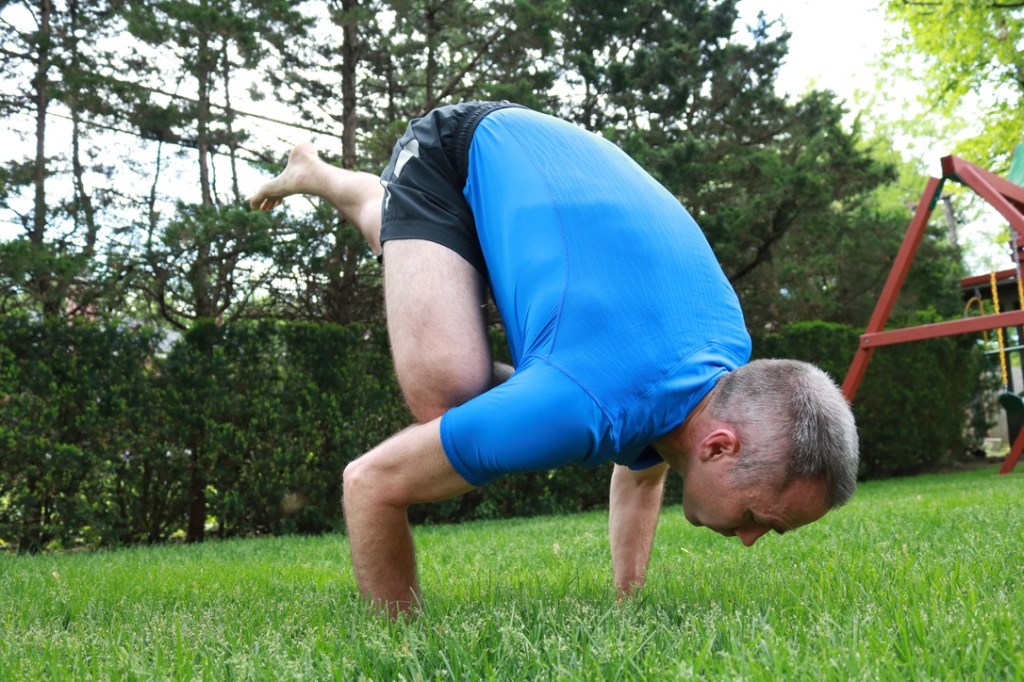
In strength and mobility vinyasa, traditional yoga poses are interwoven with variations of squats and lunges, quadrupedal (on hands and feet) bodyweight exercises, and novel ways of moving around the mat.
Unlike most yoga classes, which employ static, or passive, stretching to increase flexibility, this class emphasizes breath-connected dynamic, or active, stretching to help us develop strength throughout the full range of motion in our joints.
As a compliment to an existing yoga practice, this type of training can fill in some of the movement pieces that traditional asana and vinyasa forms often miss, and from the standpoint of developing a body that’s functionally prepared to, say, load luggage into the cargo carrier atop your minivan or work low to the ground to pick Legos out of a shag rug while fending off an exuberant puppy, it’s hard to overestimate how useful it is to learn to move fluidly through multiple planes of motion as we do in this class.
Moreover, training these movement fundamentals can go a long way toward reducing bodily pain in a way that lasts longer than an hour after class, and you may even find that it will help you unlock yoga postures or athletic patterns in other activities that you’ve been unable to master by more direct approaches.
Oh yeah, and this class, like my other classes, includes breathwork and meditation. It’s still yoga, y’all.
So that’s my spiel. If you want to get the real flavor of the class, sign up, and if you want to see my other offerings, check out my Classes page.
Thanks for reading! If you have any thoughts, leave me a comment, and if you’d like to get the blog posts to stay up with similar news as well as my musings on yoga, parenting, and the nature of reality, enter your email below.
Processing…
Success! You're on the list.
Whoops! There was an error and we couldn't process your subscription. Please reload the page and try again.
I bought a watermelon at Costco last week. It was one of those all-too-frequent moments when any preference I might have for buying local, in-season produce was utterly crushed by my preference to avoid fighting with the four-year old sitting in the shopping cart.
I don’t actually know where said watermelon was grown, but upon cutting it open, I was pleased to discover that it actually looked and tasted pretty good. That however did not change the fact that I was faced with the imposing task of trying to cut the whole thing up, and given that it’s winter in Chicagoland, I couldn’t simply chop it into wedges, put them into my children’s paws, and open the back door.
So I sliced away–surely mumbling to myself about all the other things I had yet to do–until suddenly I realized I was cutting the melon so close to the rind that half of the chunks would taste nasty and probably result in my kids passing over this unlikely winter gourd in favor of ransacking the pantry to pilfer its processed delights.
Ludicrous! Here I had this huge watermelon, which contained more watermelon than our family could possibly eat, yet I was so determined to extract every bit of fruit that I was including the unsavory bits.
Ludicrous maybe, but herein I recognized a pattern. Was this not yet another example of an often unconscious drive to extract as much out of every experience as possible, even to the detriment of my original intention?
Maybe this isn’t you, but I don’t think it’s just me. In fact, I want to argue that this is a hallmark of our culture. We’re encouraged to think of any failure to maximize our take of anything as a missed opportunity. If two is great, then three is surely better, and four would be better still. So it goes as we gobble up everything around us like Pac-Man, fleeing the ghosts of scarcity while trying claim every damn dot on the board for ourselves. Mine.
Peanut Butter from Costco (comes in a two-pack) vs. Peanut Butter for Mortals
But we are not Pac-Man. There is a point at which having more of anything, except perhaps love and consciousness, starts to offer diminishing and then inverse returns. Unfortunately, we are often too busy trying to extract all the goodness and make sure we don’t miss out that we fail to recognize when we have enough of a good thing.
So, too, with yoga practice. For even experienced practitioners, it’s very easy to fall into the trap of chasing particular sensations, experiences, or poses because we’ve become overly committed to fulfilling an ideal in our minds of what practice should look like or how it should feel.
This is not to say we shouldn’t have goals, rely on trusted techniques, or seek to alter the contents of consciousness in ways that benefit our lives, but when we become too determined to make a given practice become the perfect, Platonic, end-all-be-all practice, we lose the ability to relate to it moment by moment as it unfolds, which keeps us trapped in our mental models and makes us unable to access what is actually happening NOW. This is ironic because the distance between our mind’s abstractions and the actual present is exactly the distance yoga is designed to collapse.
Moreover, if we continue to practice in this acquisitional way, the practice itself can become a type of drudgery, an impossible attempt to satisfy the cruel master of our minds. When this happens, we not only end up missing out of on the real rasa, or nectar, that lies at the core of our own experience, we risk turning our practice into so much bitter fruit. 🍉 🤢
Thanks for stopping by. So you know, my Friday, 10 am central class through Ahimsa Yoga Studio is changing format to Strength and Mobility Vinyasa (virtual only). You can sign up here. If you’re looking for a complete list of my live classes (both in-person and virtual), check out the Classes page.
I also have a growing number of recorded classes available at a zero-dollar cost on my Youtube channel, and if you want to get these blog posts by email, enter your address below and click the blue button.
Processing…
Success! You're on the list.
Whoops! There was an error and we couldn't process your subscription. Please reload the page and try again.








 suburbanyogadad.com